

It feels like we’re reaching a crossroads with regard to ‘Artificial Intelligence’ or AI. It’s everywhere we look these days, and people increasingly left to wonder whether something we see or read is ‘real’ or AI-generated.
In technology circles, there’s undoubtedly been a rush to implement AI technologies to do anything and everything imaginable. Wether this is born out of an over-zealous desire to embrace new technologies without doing the hard work of considering the implications, a fear of being left behind, a cynical desire to increase the perceived value of a product or service (or some combination of all) is open to debate.
For Ethical Pixels®, our core purpose is to take a beat, evaluate new technologies, and advise our clients on the ethical implications of using them. Although we’ve dabbled internally in the use of Large Language Models (LLMs) and have been mostly impressed (and a little scared at times) by their potential, we’ve also come to the reluctant conclusion that AI cannot be truly ethical as a technology at this time.
Why AI usage isn't ethical (now at least)
Training data, copyright and plagiarism
Leading commercial and open-source models are all trained on huge data-sets. This includes things like notable works of art and literature, as well as scraping web data. This often includes data for which creators weren’t able to agree for usage in this way, and were not appropriately compensated. This is certainly more of a moral issue when it comes to companies that are profiting hugely from commercialising their AI models.
This isn’t settled by any stretch – ongoing billion-dollar lawsuits and legal uncertainties mean the era of scraping web data is rapidly shifting.
Users on Reddit (one of the most popular sources of AI training data) have expressed anger at their freely contributed knowledge and expertise being used to enrich the site owners and AI companies alike, and some have even gone as far as to start “poisoning the well” by piping nonsense into potential training data to confuse and undermine AI models.
Ecological concerns
Between the increased use of electricity to power AI data-centres, and the increased demand for clean water for cooling, the overall carbon and environmental footprint of AI is growing. It wouldn’t even be so much of a problem if it wasn’t that so many of the prompts are just people messing around and generating funny images.
Privacy and Ownership
Depending on the terms and conditions, anything you input to a generative AI tool can be used to train the model further, meaning you may no longer control your intellectual property or any proprietary information you feed into it – be it your own or your clients’. This should be unacceptable for any sensible business.
Disinformation
Like any new tool, AI is used to create increasingly convincing scams and allowing spammers to move faster and reach wider audiences than ever before. More insidious, however, is the trend of users swapping search engines for chatbots. Increasingly, people blindly trust AI responses even if they are incorrect.
Human impacts
AI can arguably be credited with an emerging jobs crisis. Hundreds of thousands of layoffs have been attributed to AI-based automation, taking jobs away from human workers and creators.
More worrying is mounting cognitive debt – people using AI tools extensively might be outsourcing their critical thinking faculties.
Of course we’re yet to see the long-term impacts of these changes.
Existential risks
A little on the science-fiction side here, but the quest for ever-smarter AI (and Artificial General Intelligence or AGI) raises the question – will AI overtake or destroy humanity?
It’s admittedly unlikely, but certainly worth putting controls in place to avoid. Medical advancements like cloning that had the power to dramatically change our world were regulated, so why not AI?
Are you mad? AI is the future
It’s probably true. We’re experts in Digital and Web – for us to say that we won’t embrace a watershed technology might seem baffling from an outside perspective. And yet pursuing a human-first model has largely been how we’ve delivered quality, bespoke and stable experiences for the last 7 years.
We’re not the only ones either – other principled companies have taken a stand against AI and the concerns it raises:
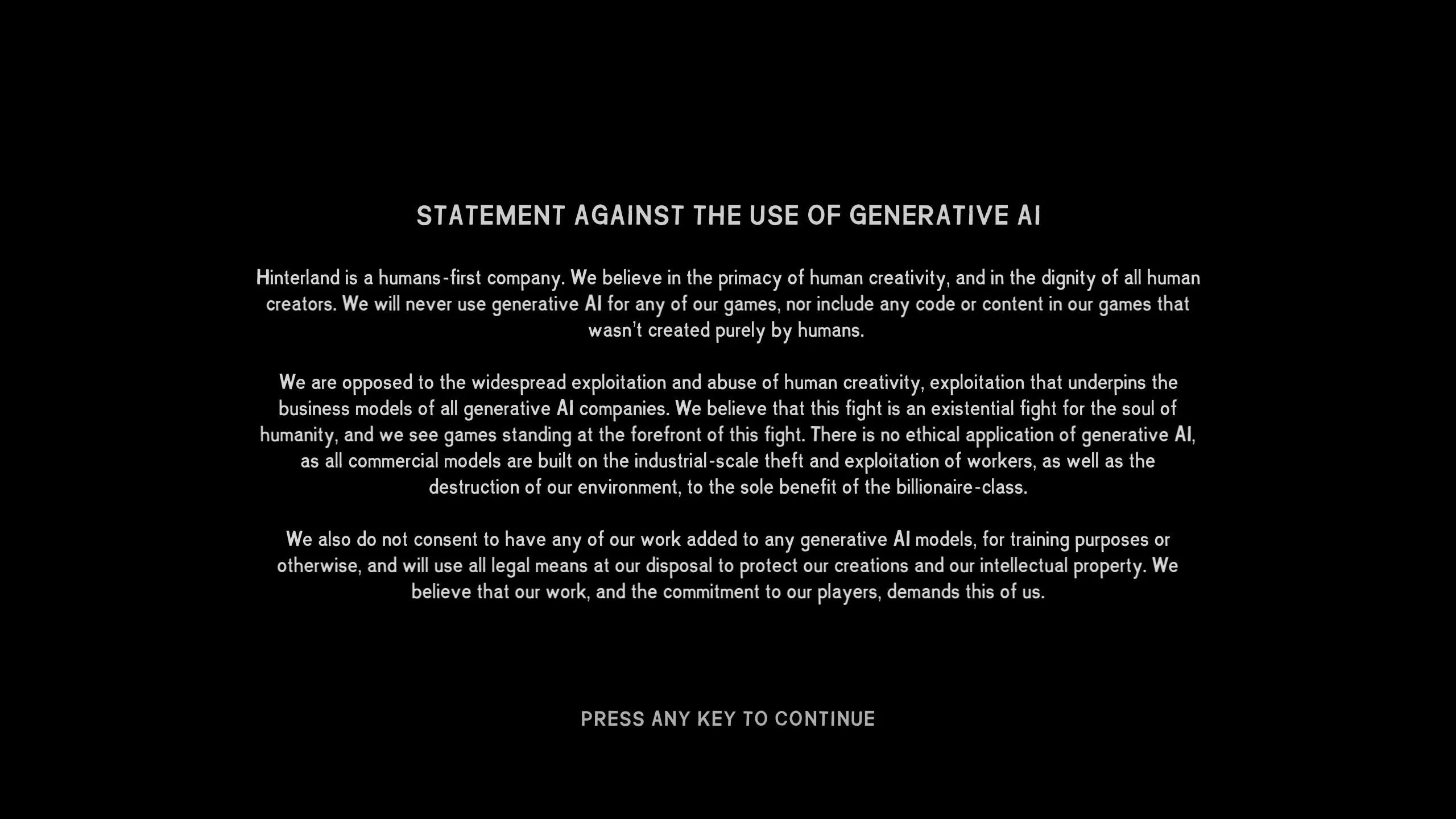
Hinterland, the Vancouver-based studio behind popular survival game The Long Dark, added this statement to the latest release of the game, garnering positive reactions from fans.
So, how does Ethical Pixels® use AI?
We’re not saying that specialist machine learning technologies don’t have positive uses – they absolutely do. Medical algorithms trained on data gathered with patient consent and used to augment human doctors in identifying different types of cancers (or even cancer precursors) is an astounding use of the technology with scope for massive positive benefits. However, widely available chatbots offer lots of very impressive-looking but dangerous pitfalls.
As such, for the first time since Ethical Pixels® was created, we’ve added a pillar to our Ethical Statement to reflect this matter and updated our AI Policy accordingly.
Ethical Pixels® is proudly a human-first consultancy. This means we don’t use generative AI tools. The work you get from us comes from people and not AI.
For us, it’s come down to either rejecting AI and keeping our principles intact, or embracing AI and throwing ethics out of the window. This doesn’t make us the cheapest option, but it does get you people who care about what you’re trying to create and understand the wider context.
Do you want a human-first digital partner?
Perhaps one day soon a provider will come to the market that provides open-source models trained on data gathered with consent, that can use fully renewable energy, has appropriate guardrails against misuse and doesn’t re-train it’s model with user input. We haven’t found one yet though. On that day, we’ll be able to gladly reconsider this position.
And before anyone says it – yes, this is a 100% human-written post right here 😉